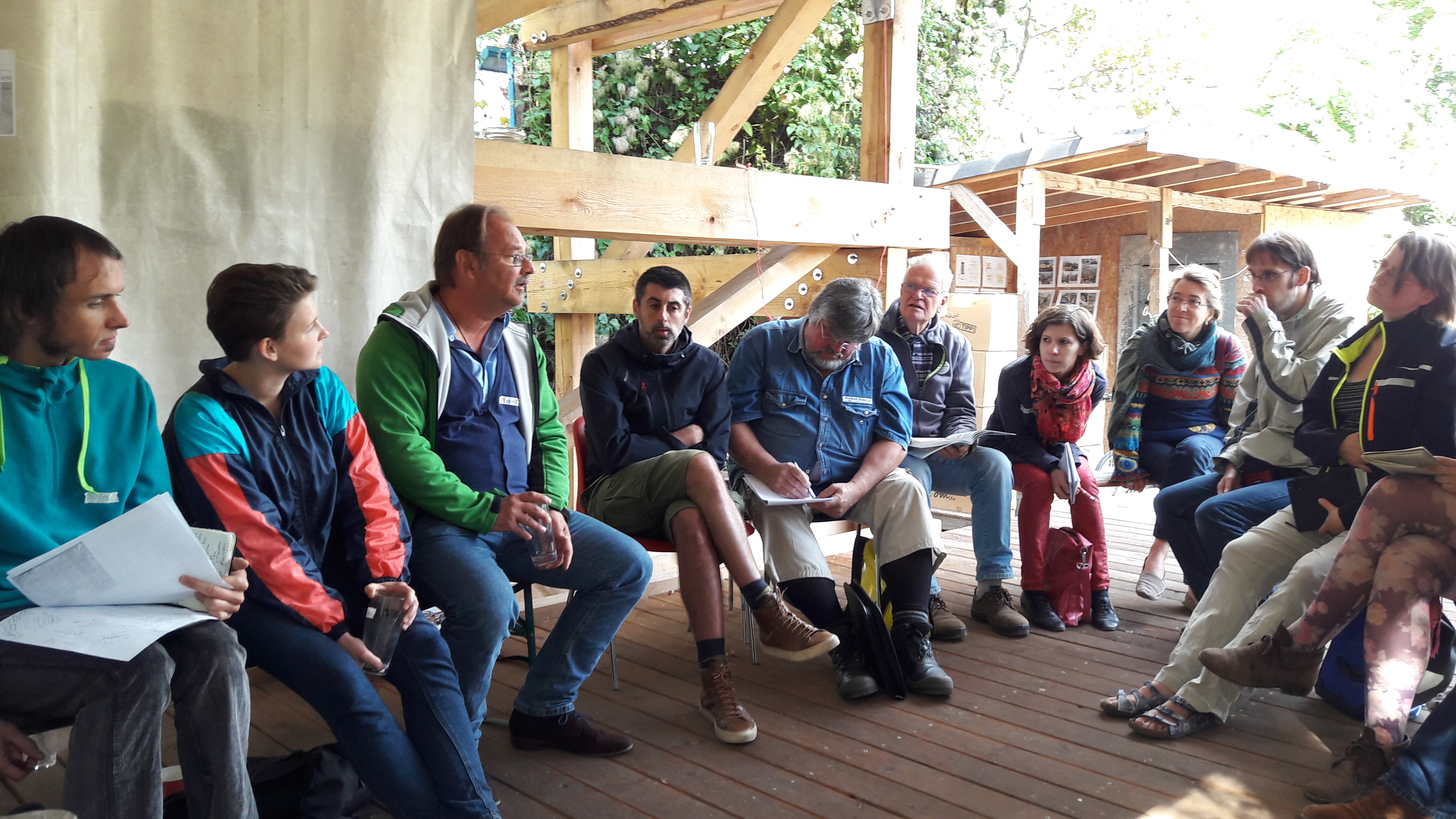
Vernetzung unter (quasi) freiem Himmel – Ende September trafen sich VertreterInnen von Reparatur-Initiativen in der Laube, dem im Selbstbau entstandenen Lernort der Nachbarschaftsakademie in den Prinzessinnengärten. Neben den Initiativen (Repair Café Brunnenviertel, Repair Café Berlin-Schöneberg, ZKU Gütermarkt, Repair Café Mariendorf, Klimawerkstatt Spandau, Repair Café Zehlendorf in Gründung) besuchten auch mehrere Interessierte, die im Bereich commons und/oder gemeinschaftliches Reparieren forschen, das Vernetzungstreffen. Die Vorstellungsrunde am Vormittag thematisiert sowohl Belange aus den alltäglichen Erfahrungen bei den Reparaturveranstaltungen und deren Organisation (großer Andrang an Gästen oder ausbleibende BesucherInnen, Umgang mit schwierigen Gästen,…), als auch die gesellschaftspolitische Relevanz des Reparierens und damit die Vision von dauerhaft geöffneten Reparatur-Angeboten zur Selbsthilfe mit Bildungsanspruch.
Vernetzung unter (quasi) freiem Himmel – Ende September trafen sich VertreterInnen von Reparatur-Initiativen in der Laube, dem im Selbstbau entstandenen Lernort der Nachbarschaftsakademie in den Prinzessinnengärten. Neben den Initiativen (Repair Café Brunnenviertel, Repair Café Berlin-Schöneberg, ZKU Gütermarkt, Repair Café Mariendorf, Klimawerkstatt Spandau, Repair Café Zehlendorf in Gründung) besuchten auch mehrere Interessierte, die im Bereich commons und/oder gemeinschaftliches Reparieren forschen, das Vernetzungstreffen. Die Vorstellungsrunde am Vormittag thematisiert sowohl Belange aus den alltäglichen Erfahrungen bei den Reparaturveranstaltungen und deren Organisation (großer Andrang an Gästen oder ausbleibende BesucherInnen, Umgang mit schwierigen Gästen,…), als auch die gesellschaftspolitische Relevanz des Reparierens und damit die Vision von dauerhaft geöffneten Reparatur-Angeboten zur Selbsthilfe mit Bildungsanspruch.
Zusammen mit Kerstin Stakemeier, Stadt von Unten und der Nachbarschaftsakademie haben wir einen Workshop zum Thema „Selbstverwaltet und kommunal. Autonomie als Bezugsgröße für Stadtpolitik(en)?“ organisiert.
Zusammen mit Kerstin Stakemeier, Stadt von Unten und der Nachbarschaftsakademie haben wir einen Workshop zum Thema „Selbstverwaltet und kommunal. Autonomie als Bezugsgröße für Stadtpolitik(en)?“ organisiert.
Zusammen mit Kerstin Stakemeier, Stadt von Unten und der Nachbarschaftsakademie haben wir einen Workshop zum Thema „Selbstverwaltet und kommunal. Autonomie als Bezugsgröße für Stadtpolitik(en)?“ organisiert.
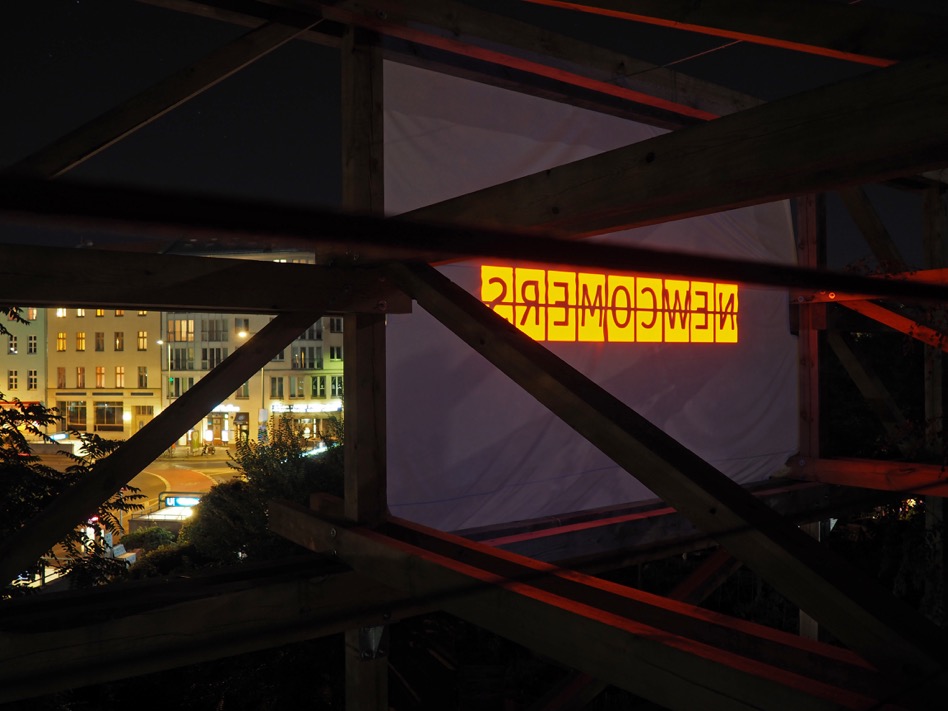
Visual Public Service (VPS) proudly presents its third intervention NEWCOMERS. These interventions evolve from conversations and observations of local communities. Through appropriation of public space, VPS will intervene the streets surrounding Oranienstrasse for 5 days (16th-21st of August).
We aim to make the unheard NEWCOMERS (Refugees) become protagonists in their new environment. The intervention aims to reflect on the subject from all possible angles. That is why we have structured our intervention in three areas: Newcomers, Berliners and Numbers & Bureaucracy.
Visual Public Service (VPS) proudly presents its third intervention NEWCOMERS. These interventions evolve from conversations and observations of local communities. Through appropriation of public space, VPS will intervene the streets surrounding Oranienstrasse for 5 days (16th-21st of August).
We aim to make the unheard NEWCOMERS (Refugees) become protagonists in their new environment. The intervention aims to reflect on the subject from all possible angles. That is why we have structured our intervention in three areas: Newcomers, Berliners and Numbers & Bureaucracy.
Visual Public Service (VPS) proudly presents its third intervention NEWCOMERS. These interventions evolve from conversations and observations of local communities. Through appropriation of public space, VPS will intervene the streets surrounding Oranienstrasse for 5 days (16th-21st of August).
We aim to make the unheard NEWCOMERS (Refugees) become protagonists in their new environment. The intervention aims to reflect on the subject from all possible angles. That is why we have structured our intervention in three areas: Newcomers, Berliners and Numbers & Bureaucracy.
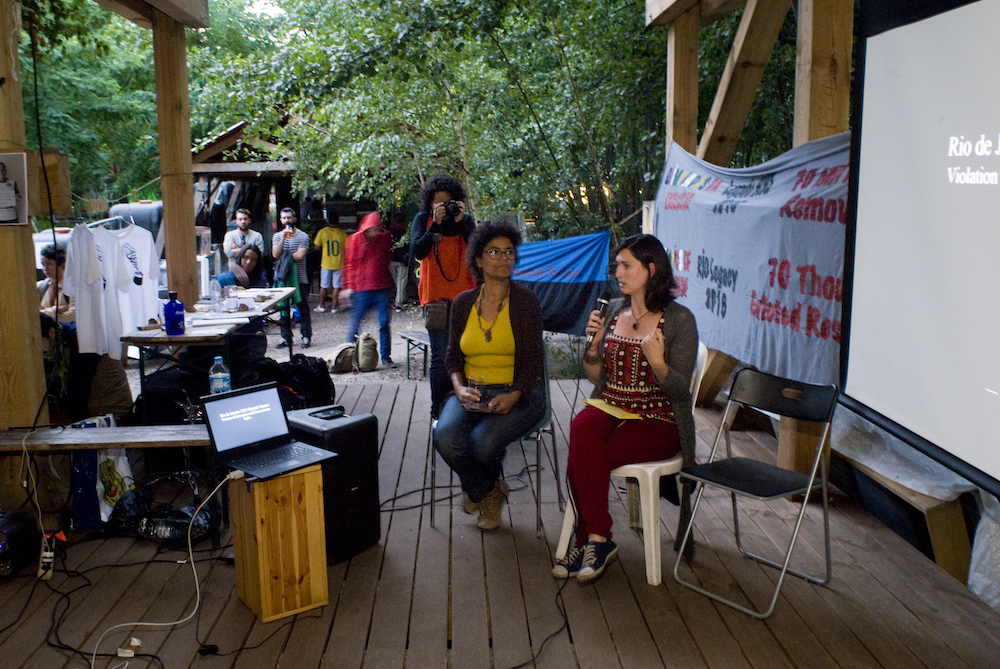
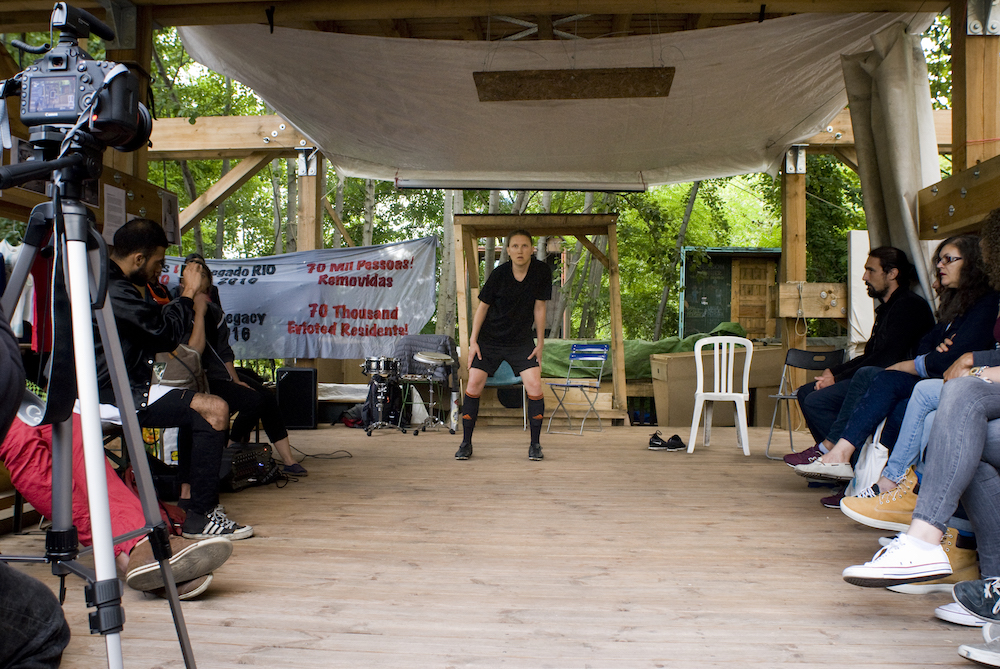
Rio de Janeiro 2016 Olympics: Exclusion and Resistance
Foto: Isaumir Nascimento
There were around 80 thousand people evicted from 33 communities in Rio de Janeiro, since 2009. Just in 2015, 644 people were killed as a consequence of police operations, lots of them part of the militarization of favelas. Environmental negative impacts and land speculation increased in an accelerated level, as part of the result of the „Olympic city“. And the democratization of media turned to be a distant horizon.
To highlight these things behind the scene and the olympic atmosphere, several social movements have taken action since the city’s election to host the Olympic Games 2016. To reveal these violations during the period of the „olympic party“, a network of around 100 social movements called Rio 2016, Jogos da Exclusão (Exclusion Games), organized diverse activities to take place in different visible places of the city of Rio. They got together in the effort named Jornada de Lutas(Journey of Struggles), starting the actions on 1st of August and running until the end of the Games. It is a result of a political struggle that has been documented (Here is the Mega-events and Human Rights Violations in Rio de Janeiro Dossier 2015 version).
Rio de Janeiro 2016 Olympics: Exclusion and Resistance
Foto: Isaumir Nascimento
There were around 80 thousand people evicted from 33 communities in Rio de Janeiro, since 2009. Just in 2015, 644 people were killed as a consequence of police operations, lots of them part of the militarization of favelas. Environmental negative impacts and land speculation increased in an accelerated level, as part of the result of the „Olympic city“. And the democratization of media turned to be a distant horizon.
To highlight these things behind the scene and the olympic atmosphere, several social movements have taken action since the city’s election to host the Olympic Games 2016. To reveal these violations during the period of the „olympic party“, a network of around 100 social movements called Rio 2016, Jogos da Exclusão (Exclusion Games), organized diverse activities to take place in different visible places of the city of Rio. They got together in the effort named Jornada de Lutas(Journey of Struggles), starting the actions on 1st of August and running until the end of the Games. It is a result of a political struggle that has been documented (Here is the Mega-events and Human Rights Violations in Rio de Janeiro Dossier 2015 version).